Last updated: March 12, 2026
Ramps and lifts both solve the same challenge. They help a passenger enter a wheelchair van safely and with dignity.
The result may look the same at the end of the ride, but the way ramps and lifts get someone into the vehicle can feel very different for the passenger and for the driver helping them.
That difference raises an important question.
Which option is the right fit for your program?
If you’re here, chances are your organization is exploring accessible transportation and trying to understand how ramps and lifts affect safety, independence, and daily operations.
You’re in the right place.
At MoveMobility, we work with organizations across Canada, like yours and Corner Brook Transit, that rely on wheelchair vans to connect people with healthcare, community programs, and everyday life. Our team installs ramps and lifts into wheelchair-accessible vans every day, so we see firsthand where each option shines and where challenges can appear.
In this article, we’ll walk through:
-
What ramps and lifts are
-
How ramps and lifts differ in full-size wheelchair vans
-
What factors inside your organization may guide the best choice
What’s the difference between wheelchair van ramps vs lifts?

Both ramps and lifts help passengers enter and exit a wheelchair van safely, but they work in very different ways.
A wheelchair van ramp is a platform that extends from the van down to the ground at an angle. A passenger rolls up the ramp and into the vehicle.
A wheelchair van lift, on the other hand, raises the passenger straight up from ground level until they reach the height of the van floor. Once level, the passenger rolls into the van.
Both systems remove mobility barriers. The experience, though, can feel very different depending on the rider, the caregiver assisting them, and the environment where the van operates.
For example, organizations working in northern Canadian communities or busy urban streets often think carefully about how ramps and lifts perform in tight parking areas, snow, or uneven surfaces.
If your goal is to provide transportation that feels smooth, respectful, and predictable for riders, understanding how ramps and lifts operate is an important first step.
Continue reading as we compare ramps and lifts across eight key factors that organizations often look at before making a decision.
8 things you should know about wheelchair van ramps

There are 8 key factors we’ll use to compare wheelchair ramps and lifts, and those are:
1. Types
2. Ease of use
3. Cost
4. Cold weather performance
5. Rear or side entry
6. Passenger comfort
7. Noise level
8. Stretcher access
1. Types
At MoveMobility, we install two main types of wheelchair van ramps. The two ramp options you’ll most often see in full-size wheelchair vans are manual ramps and powered ramps.
Each one helps passengers enter the vehicle safely, though the way they operate can feel very different for drivers and riders.
The Manual Ramp
A manual wheelchair ramp works exactly how it sounds.
You unlatch the ramp and lower it to the ground. Once it’s in place, a wheelchair user can roll up the ramp, or someone using a walker can walk into the van.
The process is simple and dependable. Many organizations appreciate that simplicity, especially when the vehicle is used frequently throughout the day.
We typically install a manual folding ramp on full-size rear-entry wheelchair vans like the TR Classic and PR Classic. These setups work well for community programs and transportation services that want a straightforward accessibility solution.
The Powered Ramp
A powered wheelchair ramp uses a hydraulic system, which means pressure from a liquid automatically moves the ramp.
Drivers activate the ramp using a control, and the ramp deploys smoothly from the van. Powered ramps often come with features that make them ideal for higher-use transportation programs.
Key features of powered ramps include:
-
Heavy-duty construction. Built for frequent daily use in transit environments.
-
Clear entryway when stored. The ramp stows away without blocking the van doorway.
-
Walk-on passenger access. The ramp can stay stored while ambulatory passengers step into the vehicle.
-
1,000 lb weight capacity. Designed to handle heavier mobility equipment.
-
Manual backup deployment. Integrated handles allow the ramp to be used if power is unavailable.
The powered ramp system is available on our P Series wheelchair vans, including the P3, P4, P5, and P6 models.
2. Ease of use
When organizations compare ramps and lifts, one question quickly rises to the top.
Who will be operating the equipment every day?
Your staff play a big role in how smoothly accessible transportation runs. Drivers and support workers may deploy the ramp several times a day while assisting passengers in and out of the van.
With a manual ramp, the driver releases the latch and lowers the ramp to the ground. After the passenger boards, the ramp folds back into place. Staff also guide or push wheelchairs up the ramp during boarding.
Manual ramps are lightweight and include a spring-assist mechanism that reduces the effort needed to lift and fold the ramp. For many programs, the system feels quick and straightforward.
That said, the task still requires some physical effort. Over the course of a full day, repeatedly pushing a wheelchair up a ramp can become demanding for staff.
A powered ramp removes most of that strain. With the push of a control, the ramp deploys automatically and returns to the stored position after boarding.
Many organizations choose powered systems when:
-
Staff rotate frequently between vehicles
-
Drivers assist passengers with higher support needs
-
The vehicle operates on busy daily schedules
3. Cost
A powered ramp typically has a higher upfront price than a manual ramp. That added cost comes from the hydraulic system, electronic controls, and heavier-duty components that allow the ramp to deploy with the push of a button.
A manual ramp, in comparison, has a simpler design. Fewer moving parts usually means a lower initial investment.
That said, focusing only on the purchase price can miss the bigger picture.
The more important question is how well the system fits the people using the van every day.
Think about:
-
Your staff. Will they be deploying the ramp many times a day?
-
Your passengers. Do riders require more support when boarding?
-
Your program schedule. Will the van operate on busy daily routes?
For many organizations, the right choice between ramps and lifts comes down to daily usability rather than the initial price tag. A system that fits your team and passengers often delivers better long-term value than one chosen purely for cost.
4. Cold weather performance
Across much of Canada, winter plays a big role in how ramps and lifts perform.
Snow, ice, and long periods of extreme cold can affect equipment in ways many buyers do not expect. That’s why climate often becomes a key factor when choosing between a manual ramp and a powered ramp.
A powered ramp uses a hydraulic system to move the ramp in and out of the vehicle. Hydraulic equipment can work very well in normal conditions, but extremely cold temperatures may slow the system down or make it harder for the mechanism to operate smoothly.
In regions with long, harsh winters, this can occasionally lead to reliability issues.
For example, organizations operating in northern communities, such as Northern Manitoba or other remote areas, often face weeks of deep cold, with temperatures regularly falling well below −30°C.
Simplicity can become an advantage in conditions like that.
A manual ramp doesn’t rely on hydraulics or electronic systems. Staff simply release the latch and lower the ramp, which means there are fewer components that could struggle in extreme cold.
For organizations serving rural or northern communities, that reliability can make manual systems a practical option when comparing ramps and lifts for year-round transportation.
5. Rear or side entry
A wheelchair ramp can usually be configured as either a rear entry or a side entry system. The right placement depends on how your organization plans to use the vehicle.
Rear-entry ramps are common for community transportation programs because they allow passengers to board from the back of the van. This can make parking easier in tighter areas or busy streets.
Side-entry ramps are often chosen when curbside loading is important, especially in urban settings where passengers board from a sidewalk.
Two popular full-size ramp conversion organizations often consider are the PR Classic and the TR Classic. These configurations are designed to support organizations that rely on dependable accessibility every day.
6. Passenger comfort
When organizations compare ramps and lifts, staff workload often becomes part of the conversation.
A wheelchair ramp must travel from ground level up to the van floor, which means the ramp can sometimes be long and fairly steep depending on the vehicle height and the space available for deployment.
In those situations, pushing a larger wheelchair or a passenger using heavier mobility equipment up the ramp can require real effort from the driver or support worker.
Over the course of a busy day, that physical demand can add up. Programs that transport several riders daily often think carefully about how ramps and lifts affect staff fatigue and workflow.
This doesn’t mean ramps are the wrong choice. Many organizations use them successfully every day. It simply highlights an important operational question.
How much physical assistance will your staff be providing to passengers during boarding?
Understanding that daily reality can help you decide whether ramps and lifts align with your team’s capacity and the needs of the people riding with you.
7. Noise level
Another detail organizations notice when comparing ramps and lifts is how much noise the equipment makes.
A manual wheelchair ramp is usually very quiet. When the ramp is lowered or folded back into the van, there are few mechanical components involved. That means there is little sound during deployment and very little rattling while the vehicle is driving.
This can make the ride feel calmer for passengers, especially for riders who may already feel anxious about transportation.
A hydraulic lift, on the other hand, relies on motors and mechanical parts to raise and lower the platform. That process can create some operational noise as the lift moves.
Both systems work well in accessible transportation. The difference is simply part of how ramps and lifts are designed to function inside a wheelchair van.
8. Stretcher access
Some organizations need their vehicles to handle more than wheelchairs.
Many manual wheelchair ramps include a swing-and-fold function. This design allows the ramp to move out of the way and open up the full rear entrance of the van.
With the ramp folded aside, the rear doorways of vehicles like the Ram ProMaster or Ford Transit can accommodate a stretcher.
That feature is especially useful for non-emergency medical transport organizations that regularly carry both wheelchair passengers and stretcher patients.
In these situations, the ramp system supports multiple mobility needs without requiring a different vehicle setup, which is why many transport programs consider this capability when evaluating ramps and lifts for their fleet.
8 things you should know about wheelchair van lifts
1. Types
The powered lift
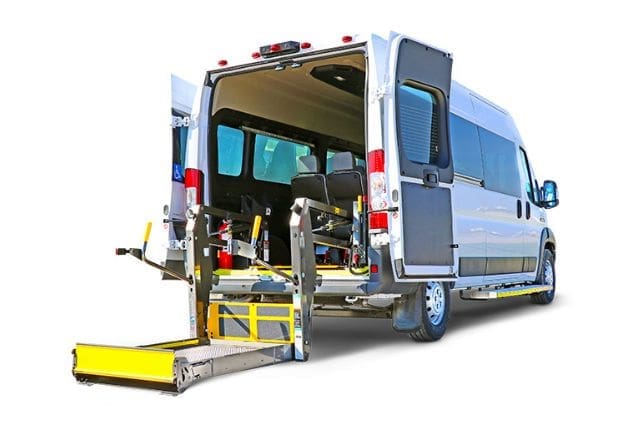
A powered wheelchair lift is a hydraulic platform operated by the driver. The lift unfolds from the rear of the van and lowers to ground level so a wheelchair user can roll onto the platform.
Once the passenger is positioned, the driver activates the controls, and the lift rises smoothly until it reaches the height of the van floor. From there, the passenger rolls forward into the vehicle, where the wheelchair can be secured for travel.
Lift platforms come in different sizes to support different mobility devices.
We offer two lift widths:
-
34-inch lift platform. Designed for standard wheelchairs and mobility scooters. This size is very popular and works well for most transportation programs.
-
37-inch extra-wide lift platform. The largest platform available. This option is usually recommended for programs that regularly transport bariatric wheelchairs or larger mobility equipment.
Choosing the right size is an important step when evaluating ramps and lifts, since wheelchair dimensions can vary widely depending on the rider’s needs.
2. Ease of use
A powered wheelchair lift is controlled using a handheld pendant. The driver presses a button and the lift deploys, lowers to the ground, and raises back to the level of the van floor.
The operator doesn’t need to lift, fold, or push any heavy components during deployment.
That design means boarding and unloading wheelchair passengers requires very little physical effort from staff. For programs that transport riders frequently, reducing lifting and pushing can help lower the risk of strain or injury for drivers and support workers.
This is one reason many organizations consider lifts carefully when planning accessible transportation. The easier the system is for staff to operate, the smoother each pickup and drop-off can feel for the passenger.
3. Cost
A powered wheelchair lift usually costs more than a manual ramp. Lift systems include hydraulic components, electrical controls, and mechanical parts that allow the platform to raise and lower safely.
That added technology increases the initial investment.
Despite the increased cost, many organizations still choose a lift system.
The reason is simple. A lift allows drivers to load and unload wheelchair passengers with very little physical effort. Instead of pushing a wheelchair up a ramp, the passenger rolls onto the platform, and the lift raises them to the van floor.
For many community programs, healthcare services, and transportation providers, that convenience can make daily operations easier for staff while creating a smoother boarding experience for riders.
4. Cold weather performance
A powered wheelchair lift uses hydraulic and electrical components to raise and lower the platform. With more moving parts involved, cold temperatures can sometimes affect how the system behaves.
Think about long stretches of freezing weather, snow buildup, and vehicles sitting outside overnight. Those conditions can slow down mechanical equipment.
For example, if a lift sits unused outside during extreme cold for several days, it may take a moment to operate smoothly the first time it’s used again.
That’s why many operators follow a simple routine to keep lifts working well.
A helpful winter habit includes:
-
Raise and lower the lift every few days: This keeps the hydraulic system moving.
-
Brush snow and ice off the platform: Clearing the surface helps the lift deploy properly.
-
Run the lift briefly during cold spells: Regular movement helps prevent stiffness in the mechanism.
None of this means lifts can’t handle Canadian winters. Many transportation programs use them every day in cold climates.
It simply highlights something important when comparing ramps and lifts. The more mechanical components a system has, the more attention it may need during long periods of cold weather.
5. Side entry or rear entry
A wheelchair lift can be installed as either a rear entry or side entry system depending on the vehicle and the conversion design.
For example:
-
Ram ProMaster: This van can support either a rear entry lift or a side entry lift, though rear entry is the most common setup for transportation programs.
-
Ford Transit: Lift systems are installed as rear entry only. Side entry lifts are rarely used because they may interfere with the vehicle’s airbag and safety systems.
Rear entry setups are often preferred for community transportation services because they allow passengers to board from behind the vehicle, which can make parking and loading easier in tight areas.
If you’d like a deeper look at the advantages of each setup, you can also explore the pros and cons of rear entry vs. side entry wheelchair vans.
6. Passenger comfort
Passenger comfort is another factor organizations think about when comparing ramps and lifts.
For many riders, boarding the vehicle is a normal part of the trip. For others, especially elderly passengers or people living with certain cognitive conditions, the experience can feel unfamiliar or unsettling.
A wheelchair lift raises the passenger straight up from the ground to the level of the van floor. During that short lift, the rider is elevated on a platform while the equipment moves.
Some passengers are completely comfortable with this. Others may feel nervous about the motion or the height while the lift is rising.
This can occasionally happen with riders who:
-
Are elderly and cautious about movement
-
Live with dementia or cognitive challenges
-
Feel anxious when equipment moves around them
In those moments, staff reassurance can make a big difference. Drivers who take a moment to explain what’s happening often help passengers feel more relaxed during boarding.
7. Noise level
A powered wheelchair lift is stored against the rear doors of the van when it’s not in use. Because of this position, the lift can sometimes move slightly while the vehicle is driving.
On rough roads or when going over bumps, that movement may create a light rattling sound.
For most transportation programs, the noise is minor and doesn’t affect how the lift operates. Still, it’s something drivers and passengers may notice during longer trips.
8. Stretcher access
A wheelchair lift is designed specifically to raise a wheelchair passenger into the van. Because the lift platform sits at the rear entrance when stored, it blocks the doorway from fully opening.
That means stretchers cannot be loaded through the back of the vehicle when a lift system is installed.
For organizations that transport both wheelchairs and stretcher patients, this can become an important limitation to consider.
Many NEMT programs look closely at this detail when evaluating ramps and lifts, especially if their service regularly includes medical transfers alongside wheelchair transportation.
Qualities to look for when choosing between ramps and lifts
Choosing between ramps and lifts comes down to one simple thing.
Your passengers.
The people using the vehicle every day should guide the decision. Their comfort, mobility needs, and confidence during boarding matter more than the equipment itself.
At the same time, your program’s daily reality also plays a role. Factors such as climate, staffing, and how often the vehicle runs can influence whether ramps or lifts work best for your organization.
Here are a few qualities that often help organizations narrow down the right choice.
Who are ramps right for?
If several of these points sound like your program, a wheelchair ramp may be the better fit.
-
You want a low-maintenance option: Ramps have fewer moving parts and tend to be simple to operate.
-
You operate in very cold climates: Organizations in northern or remote areas sometimes prefer ramps because they do not rely on hydraulic systems.
-
Your staff can assist passengers: Drivers or support workers may need to push wheelchairs up the ramp during boarding.
-
Some riders use walkers: Walk-on access can feel more natural for passengers who are able to walk but need extra support.
Who are lifts right for?
If your situation sounds more like the list below, a wheelchair lift could make more sense.
-
Your drivers want push-button convenience: Lifts deploy and raise passengers with minimal physical effort.
-
Your area experiences milder winters: Programs operating in moderate climates often find lifts easy to maintain year-round.
-
Passengers use heavier wheelchairs: Lift platforms can make boarding easier for larger mobility devices.
Many organizations spend time weighing these factors before deciding between ramps and lifts. The goal is always the same. Give passengers a boarding experience that feels safe, smooth, and respectful.
If you’d like a deeper look at how lift systems work, you can also explore our guide covering the pros and cons of wheelchair lifts in more detail.
Your next steps in choosing a ramp or lift for your wheelchair van
You came here looking for a clear answer.
Is a ramp or a lift the better choice for your organization?
Now you’ve seen how ramps and lifts work, where each option performs best, and what qualities inside your program can help guide the decision.
In the end, the right choice usually comes down to three things:
-
Your passengers and their mobility needs
-
How your transportation program operates day to day
-
The environment your vehicles operate in
At MoveMobility, we work with wheelchair-accessible vans every day and regularly help organizations evaluate which setup fits their passengers and operations best.
If you’re still unsure which option best fits your program, you can connect with a MoveMobility expert to discuss your situation.
Or, learn more about wheelchair-accessible vehicles by checking out these related articles:

 English
  French