Updated: September 25, 2026
You know your community needs better access to healthcare. You may already know what services you want to offer and who you need to reach. Then you hit the question that stops many mobile health projects in their tracks: How are we going to pay for the vehicle?
At MoveMobility, we’ve spent more than 20 years working in accessible transportation and mobile healthcare. In the past three years alone, we’ve manufactured more than 180 mobile medical units for organizations serving communities across Canada. That experience has shown us that funding becomes much easier to approach when you know where to look and what information to prepare before an application opens.
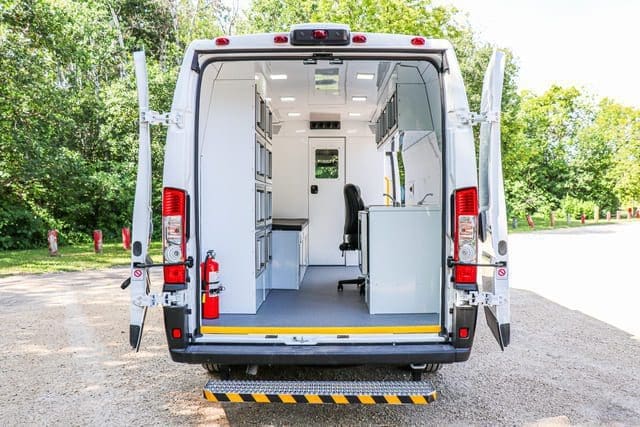
In this article, we’ll look at where you can search for funding for a mobile medical vehicle, how to prepare your project, what funders usually want to see, and how to build a stronger application.
How do you apply for funding for a mobile medical vehicle?
Applying for funding for a mobile medical vehicle starts before you fill out an application form. You need to define the problem your program will solve, estimate what the project will cost, find funding that fits, gather supporting information, and connect your project to the funder’s goals.
A simple process looks like this:
| Stage | What you need to do | What you should have ready |
| 1. Define the need | Explain the healthcare barrier you’re trying to solve | Community data, service gaps and people affected |
| 2. Define the program | Decide what services you’ll deliver and where | Service plan, routes, staffing needs and expected users |
| 3. Build a budget | Estimate the vehicle, equipment and program costs | Vehicle quote and other project expenses |
| 4. Find funding | Look for programs that match your project | Eligibility rules, deadlines and eligible expenses |
| 5. Build your case | Connect your project to the funder’s goals | Outcomes, data, partnerships and letters of support |
| 6. Submit | Follow the application instructions closely | Final documents, approvals and required forms |
| 7. Prepare for approval | Get ready to move once funding is confirmed | Updated quote, vehicle requirements and internal approvals |
One common mistake is jumping straight to Step 4.
Searching for grants before you’ve defined the project often leads to hours of reading funding opportunities that were never a good fit.
Start with the problem instead.

What should you do before you search for funding?
Before searching for funding, define who needs help, what barrier they’re facing, what service you’ll provide, and how a mobile program will improve access. Funders need to understand the problem before they can understand why a vehicle belongs in the solution.
Imagine your health team serves several Northern Manitoba communities.
Residents currently travel hours for basic appointments. Some don’t have reliable transportation. Others delay care because making the trip means missing work, arranging childcare, or finding someone to drive them.
Your funding application shouldn’t begin with:
We would like funding to purchase a mobile medical vehicle.
The stronger story is the service gap.
Your organization is trying to bring care closer to people who struggle to reach it.
Start by answering questions such as:
- Who will you serve: Define the communities and groups that will use the program.
- What barrier exists today? Explain why people aren’t getting the care or support they need.
- What services will you provide: Be clear about screenings, primary care, counseling, outreach, harm reduction, wellness checks, or other services.
- Where will you operate: Identify communities, neighborhoods, rural routes, or regions.
- How often will you provide service: Estimate clinic days, outreach stops, or visits.
- What will improve: Explain what better access looks like for the people you’re serving.
This gives you the foundation for a more focused funding search.
Instead of searching only for “mobile medical vehicle grants,” you can look for funding tied to rural healthcare, Indigenous health, mental health, community outreach, health equity, transportation access or the service your program will deliver.
Now you need to know where to look.
Where do you look for funding for mobile medical vehicles?
There isn’t one Canadian website that lists every funding source for mobile medical vehicles. Your best approach is to check several types of funding databases and government programs. Search according to the problem you’re solving as well as the vehicle itself, since many useful opportunities won’t include “mobile medical vehicle” in their title.
Here are five places to start.
1. GrantWatch
GrantWatch’s Canadian grant database is a useful place to search because it brings government, foundation, corporate, and other funding opportunities into one database.
The site has changed since the original version of this article was published. Instead of following the older step-by-step menu shown in that article, you can now use GrantWatch’s advanced search filters to narrow down opportunities based on your organization and program.
Useful categories include:
- Health and medical
- Mental health
- Transportation
- Community services
- Capital funding
- Disabilities
- Substance abuse
- Homeless
- Municipalities
- Tribal Nations
You can also filter according to recipient type, including:
- Nonprofits
- Government
- Small businesses
- Colleges and universities
- Individuals
GrantWatch also lets you narrow results by funding source, deadline, location and keywords. Its dedicated Canadian Health and Medical section currently includes hundreds of healthcare-related opportunities, although the exact number changes as grants open and close.
This is where thoughtful search terms help.
Don’t search only for:
mobile medical van
Also, try terms connected to what your program will accomplish, such as:
- Rural health
- Indigenous health
- Healthcare access
- Mental health
- Harm reduction
- Substance use
- Community outreach
- Seniors
- Homelessness
- Disability
- Primary care
- Capital equipment
A mental health grant, for example, won’t always advertise itself as funding for a mobile counselling unit. You need to open the opportunity and check whether a vehicle, equipment or other capital expense is eligible.
Some GrantWatch information and advanced features require a paid membership, so your team should decide if you’ll use the database often enough to make that worthwhile. GrantWatch says free accounts provide access to grant listings and some basic tools, while its fuller search and tracking features require its paid membership.
2. Government of Canada grants and funding
The federal government should be another regular stop in your funding search.
The Government of Canada grants and funding directory organizes federal funding according to areas such as health, Indigenous peoples, business, research and other program types.
For a mobile healthcare program, the health section is a logical starting point.
Health Canada maintains a current funding page for healthcare projects that brings together health-related grants, contribution programs and other funding opportunities.
The Public Health Agency of Canada also publishes funding opportunities for public health projects.
Federal opportunities often have very specific goals. One funding call could focus on health equity. Another could support mental health, substance use, sexual health, chronic disease prevention or underserved communities.
That’s why your search should start with your program rather than the vehicle.
For example, if your organization wants to operate a mobile outreach clinic focused on people experiencing homelessness, search funding connected to:
- Community health
- Health equity
- Homelessness
- Mental health
- Substance use
- Social development
Then check whether the costs needed to run your mobile program are eligible.
3. Indigenous Services Canada and Indigenous funding programs
First Nations, Inuit and Métis organizations should also search funding programs specifically created for Indigenous communities and organizations.
The Government of Canada’s Funding for Indigenous Peoples page brings several federal funding sources together, including programs from Indigenous Services Canada and Crown-Indigenous Relations and Northern Affairs Canada.
Indigenous Services Canada also maintains its own funding programs directory, organized into areas such as:
- Health
- Infrastructure
- Social programs
- Emergency management
- Housing
- Education
Some programs use open calls for proposals, while others work through existing funding agreements or specific eligibility requirements.
This distinction is important.
Finding a program related to healthcare doesn’t automatically mean it will pay for a mobile medical vehicle. Look closely at:
- Who can apply
- What expenses are eligible
- How proposals are accepted
- Funding limits
- Application dates
- Program goals
For a First Nation trying to bring healthcare into a remote community, the strongest case usually starts with the access barrier.
The vehicle then becomes part of the plan to close that gap. You can also explore how mobile clinics benefit First Nations when building the case for community impact.
4. Provincial and territorial funding websites
Provincial and territorial governments offer their own grants, transfer payments and contribution programs. These are worth checking because healthcare delivery, community services, addictions, mental health and many other services are funded partly at the provincial or territorial level.
Programs vary widely across Canada, and there isn’t one identical grant portal used by every province.
Start with the official government website for your province or territory:
- Alberta
- British Columbia
- Manitoba
- New Brunswick
- Newfoundland and Labrador
- Nova Scotia
- Ontario
- Prince Edward Island
- Québec
- Saskatchewan
- Northwest Territories
- Nunavut
- Yukon
Search for terms related to the service you’re planning, including health, community services, accessibility, mental health, addictions, rural development, Indigenous services, and capital funding.
Ontario, for example, maintains a current Government of Ontario funding opportunities page and uses Transfer Payment Ontario for many provincial funding applications. Organizations can review available programs, eligibility requirements, deadlines, and application instructions through the provincial system.
MoveMobility also publishes articles about individual programs when they’re relevant, such as the Ontario Transit Investment Fund, Rural Economic Development Program, Manitoba Accessibility Fund, and Community Development Fund.
Don’t stop after one visit.
Provincial funding changes throughout the year as programs open, close, and receive new budgets. Bookmark the funding pages that apply to your organization and check them regularly.
5. Foundations, community funders, and other grant programs
Government programs aren’t your only option. Foundations, charities, corporations, community foundations, and other funders also support healthcare, social services, and community projects across Canada.
This is another area where searching according to your mission works better than searching only for a vehicle.
A community foundation probably isn’t advertising a “mobile medical van grant.”
It could instead have funding for:
- Community health
- Seniors
- Mental health
- Indigenous programs
- Poverty reduction
- Rural services
- Youth
- Accessibility
- Community development
Look at foundations and major funders active in your region, then check their eligibility rules and past funding priorities.
Community foundations can be especially useful because their funding is often tied to needs within a specific city, region or province.
You can also use GrantWatch to uncover private foundation and corporate opportunities alongside government programs.
If grants aren’t your only option, you can also explore fundraising for a mobile medical van as another way to build your project budget.
The important part is checking the original funder’s website before you apply. Grant databases are useful for finding opportunities, but the original program page should be your final source for eligibility, deadlines, and application rules.
Don’t rely on one funding website
Using more than one funding source gives your organization a better view of what’s available.
A practical funding search could include:
1. Check GrantWatch
2. Check federal health funding
3. Check Indigenous funding programs, if applicable
4. Check your provincial or territorial funding portal
5. Check relevant foundations and community funders
6. Review MoveMobility’s Funding Opportunities Hub: MoveMobility maintains a Funding Opportunities Hub where we share funding programs that could be relevant to accessible transportation, mobile healthcare, and community services.
No single search will find every opportunity.
Funding is often about timing. A program that doesn’t fit today could reopen next year, while a new funding call could appear next month.
Once you have a few possible opportunities, the next step is making sure your project is ready for them.
What information should you gather before applying?
Prepare your community need, program plan, budget, vehicle information, expected outcomes, and supporting documents before the deadline gets close. Having this information ready makes it easier to judge funding opportunities quickly and prevents your team from scrambling for quotes, numbers, and approvals at the last minute.
Your community need
Funders need a clear reason to support the project.
Describe what people experience today.
For example, a rural community could have residents travelling several hours for routine appointments. An urban outreach program could be trying to reach people experiencing homelessness who rarely enter a traditional clinic.
Use local evidence when you have it.
That could include:
- Community surveys
- Service wait lists
- Transportation data
- Current client numbers
- Distance to existing services
- Referral data
- Community health assessments
- Feedback from local partners
Keep the connection simple: This is the problem, these are the people affected, and this is how our program responds.
Your service plan
Explain what happens after your program receives funding.
A funder should be able to picture the program in action.
For example:
Your team plans to visit four communities each month. A nurse and outreach worker will provide health checks, referrals and follow-up support. The mobile unit gives them a private space to meet people closer to home.
If you’re still deciding how the program itself should work, our guide on starting a mobile medical clinic covers the larger planning process.
Specific plans are easier to understand than broad promises.
Your expected outcomes
Think about what success looks like for the people using your service.
Depending on the program, you could track:
- Number of communities reached
- Number of clinic days
- Number of patient visits
- Number of screenings
- Number of referrals
- Reduced travel distance for clients
- Increased access to services
- Follow-up appointments completed
These outcomes help show how mobile medical vans save lives and improve access when they’re connected to a clear community need.
Focus on outcomes your team can realistically track.
How should you build a budget for the funding application?
Build your budget around the complete project rather than guessing at the price of a vehicle. Start with a current vehicle quote, then identify medical equipment, delivery, staffing, technology, supplies and operating expenses if the funding program allows them. Always check the program’s eligible expense rules before submitting your numbers.
Mobile medical vehicles are a large investment, and the final price depends heavily on the type of unit and its configuration.
MoveMobility’s mobile medical van cost guide provides detailed pricing information and explains what affects the final cost.
Keep the full cost discussion there rather than trying to rebuild your budget from this article.
For your funding application, think about expenses in categories.
Vehicle and conversion
This could include:
- Vehicle chassis
- Interior conversion
- Seating
- Cabinetry
- Heating and cooling
- Electrical systems
- Lighting
- Privacy features
- Accessibility equipment
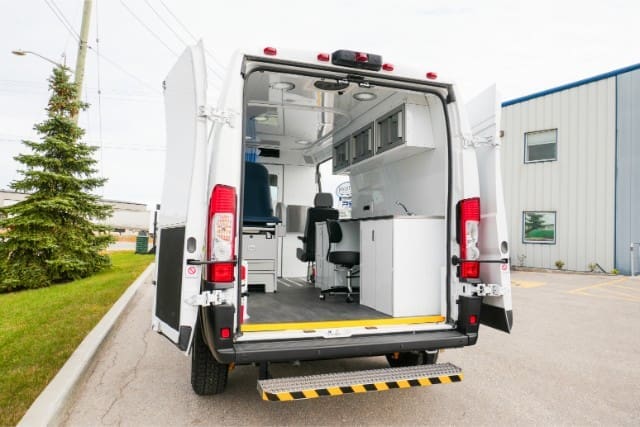
Some of these choices depend on mobile medical van customization, so having a clearer idea of your required layout helps make your budget more accurate.

Medical and program equipment
Your program could also need items such as:
- Examination equipment
- Refrigeration
- Medical storage
- Computers or tablets
- Internet equipment
- Clinical supplies
- Counselling furniture
You can learn more about mobile medical equipment that can be installed inside a clinic when you’re building this part of the budget.
Program expenses
Some funding programs also support expenses beyond the vehicle.
Those could include staffing, fuel, insurance, training, outreach materials, or evaluation.
Don’t assume they’re eligible.
Read the funding rules first and separate eligible expenses from expenses your organization will pay through another source.
How do you show that your project fits the funder’s goals?
Connect the problem in your community directly to the outcomes the funding program is trying to create. Use the funder’s stated goals as a guide, then show how your mobile program supports those goals through specific services, locations and measurable results. The vehicle should support the story rather than become the whole story.
Suppose a funding program wants to improve access to mental health services in rural communities.
Your application could explain:
- Current state: People in three rural communities travel more than an hour to reach counselling services.
- Barrier: Transportation and distance cause some people to delay or skip appointments.
- Program: Your counselling team will travel to each community using a private mobile counselling space.
- Expected result: Residents have more opportunities to meet a counsellor closer to home.
That’s a much stronger connection than saying your organization wants a new van.
The funder sees the problem, the response and the human result.
MoveMobility has a separate guide covering five things that make a successful grant application. It goes deeper into wording, evaluation criteria, letters of support, measurable goals and project feasibility.
Keep those proposal-writing details there.
For this stage, your goal is simpler: prove that your proposed program fits the purpose of the funding opportunity.
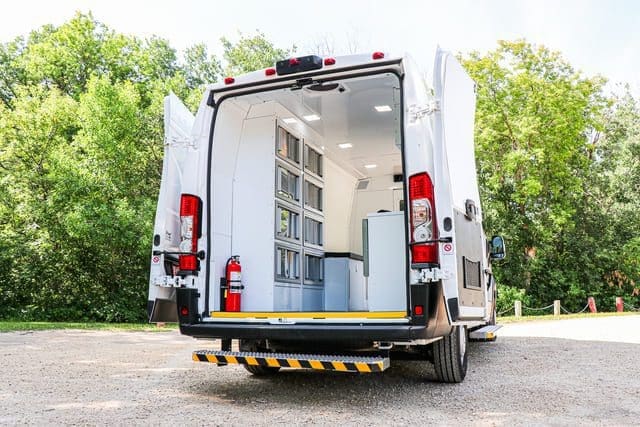
What should you do before submitting the application?
Review the eligibility rules, eligible expenses, deadline, required documents, and evaluation criteria before you submit anything. Then have someone outside the project read your application. They should be able to understand the problem, who you’re helping, what you’re proposing, how much it costs, and what will improve without needing extra explanation.
A final review should answer these questions:
- Are we eligible: Confirm your organization type, location, and project meet the program rules.
- Is the vehicle eligible: Check that capital expenses or vehicle purchases are allowed.
- Does our budget match our request: Every major expense should be clear and supported.
- Did we answer every question: Don’t lose points because a required section was skipped.
- Is our impact clear: Show what changes for the people your program serves.
- Are our numbers consistent: Your quote, budget and written application should tell the same story.
- Did we follow the instructions: File types, signatures, page limits, and deadlines still count.
Give yourself room for approvals, too.
A board signature, finance approval, partnership letter or updated quote can become a frustrating last-minute roadblock when the deadline is tomorrow morning.
If you’re still developing the overall project, the five steps to buying a mobile medical van can also help you understand what information you’ll need as the project moves forward.
What happens after you submit your funding application?
After submission, keep your project information current and prepare for the next step. Funding decisions can take time, and vehicle pricing, availability or program requirements can change while you wait. Staying prepared means your organization can move more quickly if funding is approved or respond clearly if the funder requests more information.
Don’t treat submission day as the end of the project.
Keep copies of:
- Your completed application
- Your vehicle quote
- Your project budget
- Letters of support
- Program plans
- Any emails from the funder
If the application isn’t successful, review any feedback you receive.
That work doesn’t have to disappear.
Your community needs, budget, service plan, and supporting evidence can often become the starting point for another opportunity.
If funding is approved, your attention moves from “How do we pay for this?” to “How do we get the program on the road?”
MoveMobility explains what happens during that waiting period in Can a vehicle be held while we secure funding?, including preparing specifications, quotes, and other information before funds are released.
FAQ about funding for mobile medical vehicles
Q: Does a grant have to cover the full cost of a mobile medical vehicle?
A: No. Some organizations combine a grant with their own capital budget, donations, foundation support or another funding source. Check each program’s rules before combining funds because some funders require you to disclose other contributions. You can also review MoveMobility payment options when planning how the remaining portion could be funded.
Q: Do I need a vehicle quote before applying for funding?
A: Many applications are stronger when you have a current quote because it gives the funder a clear project cost. Some programs also require quotes or supporting cost information. Ask for one early enough that your team has time to review it before the deadline.
Q: Can funding pay for medical equipment inside the vehicle?
A: It depends on the program. Some funding covers capital equipment, while other programs limit what they’ll pay for. Read the eligible and ineligible expense sections carefully before adding medical equipment to your request.
Q: What if a funding opportunity doesn’t mention mobile medical vehicles?
A: Look at what the program is trying to achieve. Funding for rural health, mental health, addictions, outreach or community health could still fit a mobile program if your organization and expenses meet the eligibility rules. Understanding the different uses of mobile clinics can help you connect your program to the funder’s goal.
Q: How early should we start looking for funding?
A: Start before you urgently need the vehicle. Defining your program, building a budget, collecting community data, and getting internal approvals takes time. Early preparation also makes it easier to respond when a short application window opens.
Q: Can we apply for more than one funding opportunity?
A: Often, yes, but every program has its own rules. Be transparent about other funding sources and check for restrictions on using multiple grants for the same expenses.
Q: Does MoveMobility submit funding applications for organizations?
A: MoveMobility doesn’t submit grant applications on your organization’s behalf. We can provide vehicle information, pricing, and specifications that your team can use when preparing an application.
Take the next step with funding for mobile medical vehicles
You started researching because your team has a service you want to bring closer to people, but funding stands between the idea and the people you’re trying to reach.
You now have a clearer path forward:
- Need: Define the healthcare or access barrier your program will address.
- Search: Know where to look for relevant funding opportunities.
- Program: Explain who you’ll serve, where you’ll go, and what you’ll provide.
- Budget: Gather realistic vehicle and project costs.
- Funding fit: Match your project to programs connected to the outcome you’re trying to create.
- Application: Show how your project supports the funder’s goals.
With those pieces in place, funding research becomes far less like searching for a lucky grant and more like matching a well-planned program with the right opportunity.
The bigger goal is getting care closer to the people who need it. For someone in a rural community, that could mean fewer hours spent travelling for an appointment. For someone experiencing homelessness, it could mean meeting a healthcare worker somewhere they already feel comfortable. And for your team, it means having another way to remove barriers between people and the services built to support them.
Our experience at MoveMobility goes beyond supplying a vehicle quote. We’ve supported healthcare providers, Indigenous communities, nonprofits, and community programs across Canada as they plan mobile services around the people they serve. Our mobile medical work is backed by Canada’s National Safety Mark on applicable vehicles, Ford Pro Upfitter recognition, and Stellantis QPro certification.
That experience helps us answer the practical vehicle questions that often come up while organizations are planning funded projects. Most importantly, it helps organizations remove barriers for the people depending on them.
If you have questions about the vehicle, layout, specifications or pricing you need for your funding application, click the button below to talk to a mobility expert.
If you’re still researching before speaking with someone, these resources will help you take the next step.
What should you read next?
- How much does a mobile medical van cost?: Build a more realistic funding target by understanding current mobile medical vehicle pricing and what affects the final cost.
- Top 5 things that make a successful grant application: Once you’ve found an opportunity that fits, use these tips to strengthen the application you submit.
- Can a vehicle be held while we secure funding?: Learn what your team can prepare while you wait for a funding decision so you’re ready to move when approval arrives.
 English
  French